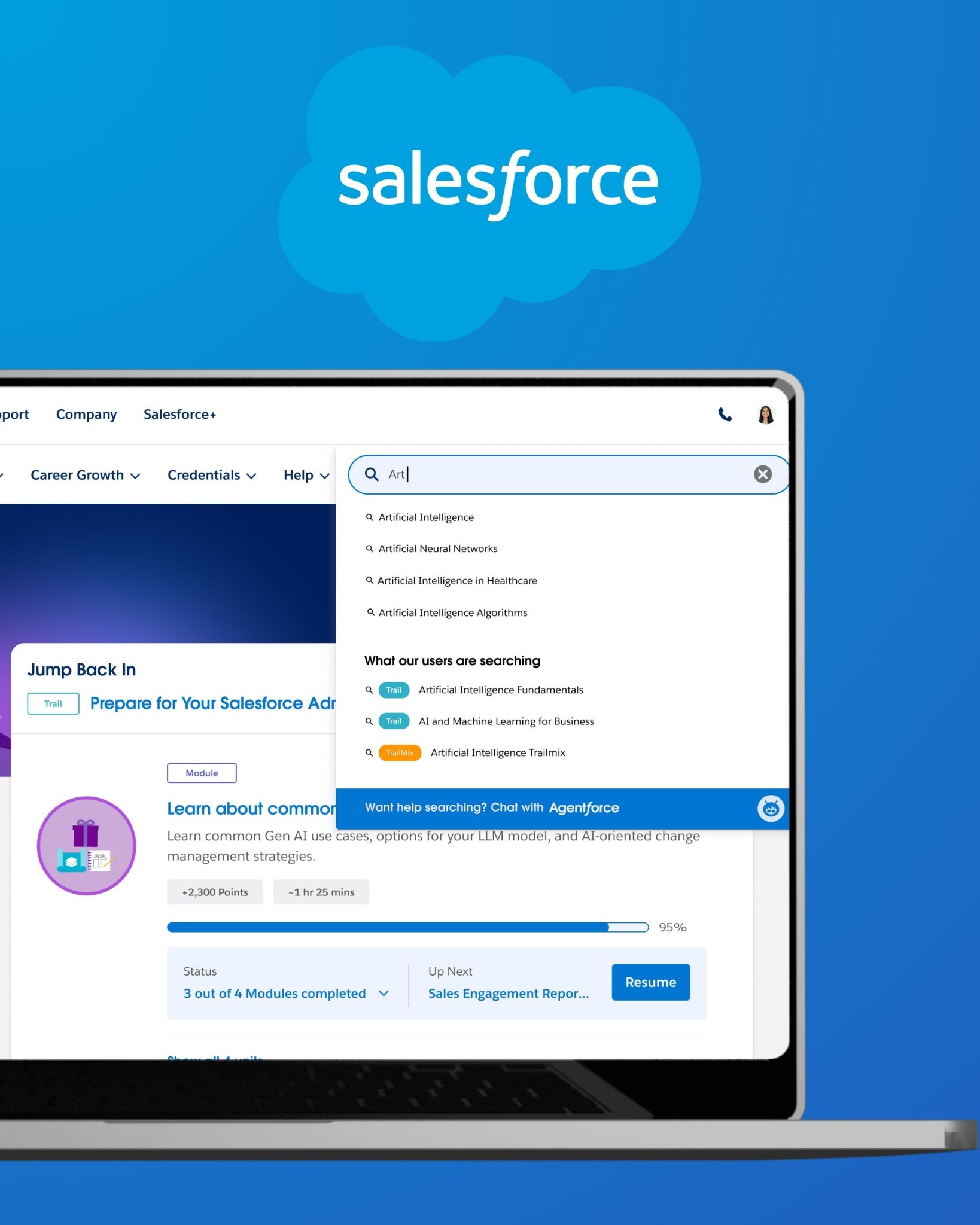
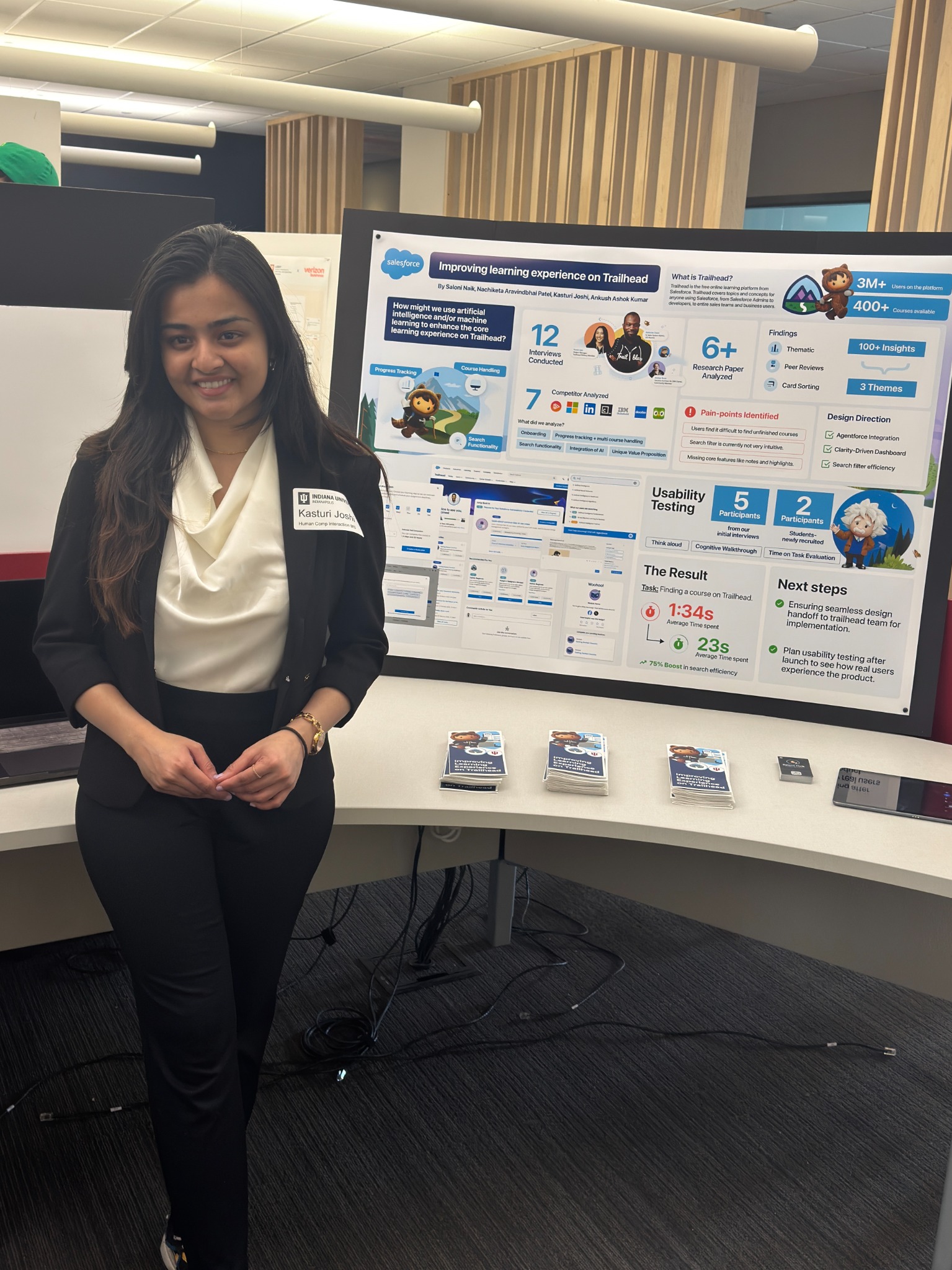
End-to-end UX research · Mixed methods · Search & discovery
Turning Trailhead search into a guided path to learning.
I led end-to-end research to understand why learners searched and filtered extensively—but still abandoned course discovery. Salesforce is a global CRM platform, and Trailhead is its learning ecosystem for building product, technology, and business skills. The work translated behavioral evidence into a more guided, efficient search experience.
Measured75%
faster course discovery in evaluative usability testing
ObservedVP + team
research and recommendations presented to Trailhead leadership
Projected scale3M+
learners who could benefit annually from an improved journey
The flow was generating activity without enough learner progress.
Search is a primary entry point into Trailhead. Learners were interacting with filters, but that activity was not consistently translating into course starts.
User risk
Effort without confidence
Learners spent time searching and filtering, yet still struggled to decide which course was relevant.
Business risk
Cost without conversion
Each filter refresh increased third-party search activity without reliably leading to a course start.
Product risk
Friction at the gateway
Drop-off at a primary entry point could weaken long-term engagement and adoption.
“Search is the gateway to Trailhead. If users abandon here, we risk losing engagement and adoption in the longer run.”
Amina Dieng · Senior Product Manager
High filter interaction was not translating into meaningful progression toward starting a course.
02 · Research strategy
I moved from broad signals to observed behavior.
I began with candid public feedback to identify recurring problem areas, then used interviews and task-based usability testing to understand the mental models and behaviors behind them.
Exploratory
80+
Public user reviews
Reddit discussions, YouTube comments, and Quora posts surfaced recurring themes such as discoverability, option overload, and uncertainty about course relevance.
Generative
12
User interviews
Scenario-based conversations explored starting points, expectations, prior search experiences, and workarounds when learners were unsure what to search.
Evaluative
12
Usability testing sessions
Participants completed a job-relevant course-discovery task while I captured time, decision points, filter behavior, confusion, and abandonment signals.
The study focused on three decisions.
Starting pointHow do learners decide what to search for?
Revealed expectations, mental models, and uncertainty.
FrictionWhere does the discovery journey break down?
Connected hesitation, filters, and abandonment.
BehaviorWhat do learners do when search is not helping?
Surfaced workarounds and reliance on recommendations.
03 · Research pivot
The research pivot changed how I compared learner behavior.
I began by recruiting across job roles. Early sessions showed that Trailhead familiarity explained discovery behavior more clearly, so I compared both role-based and expertise-based patterns.
What changed
I added product expertise as a second lens—not a replacement for role.
This pivot made the comparison more useful. Role still provided context, while product expertise better explained why novice learners moved through the full flow and experienced learners often skipped it for recommendations.
Role lensDesigner, developer, program manager, administrator
DecisionCompare discovery behavior across role and product expertise
The recruitment strategy evolved as a stronger behavioral pattern emerged.
04 · What the research revealed
Three behaviors explained why search activity did not become progress.
The issue was not low motivation. The experience asked learners to make decisions without enough guidance, relevance, or relief from repeated work.
01
Novice learners did not know where to begin.
They arrived with broad learning goals, hesitated before searching, and struggled to judge whether a course matched what they needed.
Research implication Guide discovery before asking learners to form a precise query.
Observed behavior: uncertainty at the first step of search.
02
Experienced learners bypassed search.
7 of 12 participants skipped the intended search flow and relied on recommendations already surfaced on the dashboard.
Research implication Match a recognition-first mental model by surfacing relevant options earlier.
Observed behavior: using surfaced recommendations instead of constructing a search.
03
Filtering created effort without confidence.
Participants spent an average of 0.7 minutes applying similar filter combinations and still questioned whether results were relevant.
Research implication Treat high filter use as friction and reduce repeated setup.
Observed behavior: repeated filtering increased time and fatigue.
05 · Synthesis
The findings became three questions that guided the next research decisions.
I used the findings as a benchmark for ideation so every later opportunity could be traced back to observed learner behavior.
How might we
help novice learners begin with clarity and confidence?
Support discovery before asking for a precise query.
How might we
align search with experienced learners’ reliance on recommendations?
Surface relevant options earlier and reduce recall.
How might we
reduce repeated effort and fatigue while filtering?
Make useful preferences faster to apply and reuse.
Journey mapping
I mapped where each opportunity appeared across the discovery journey.
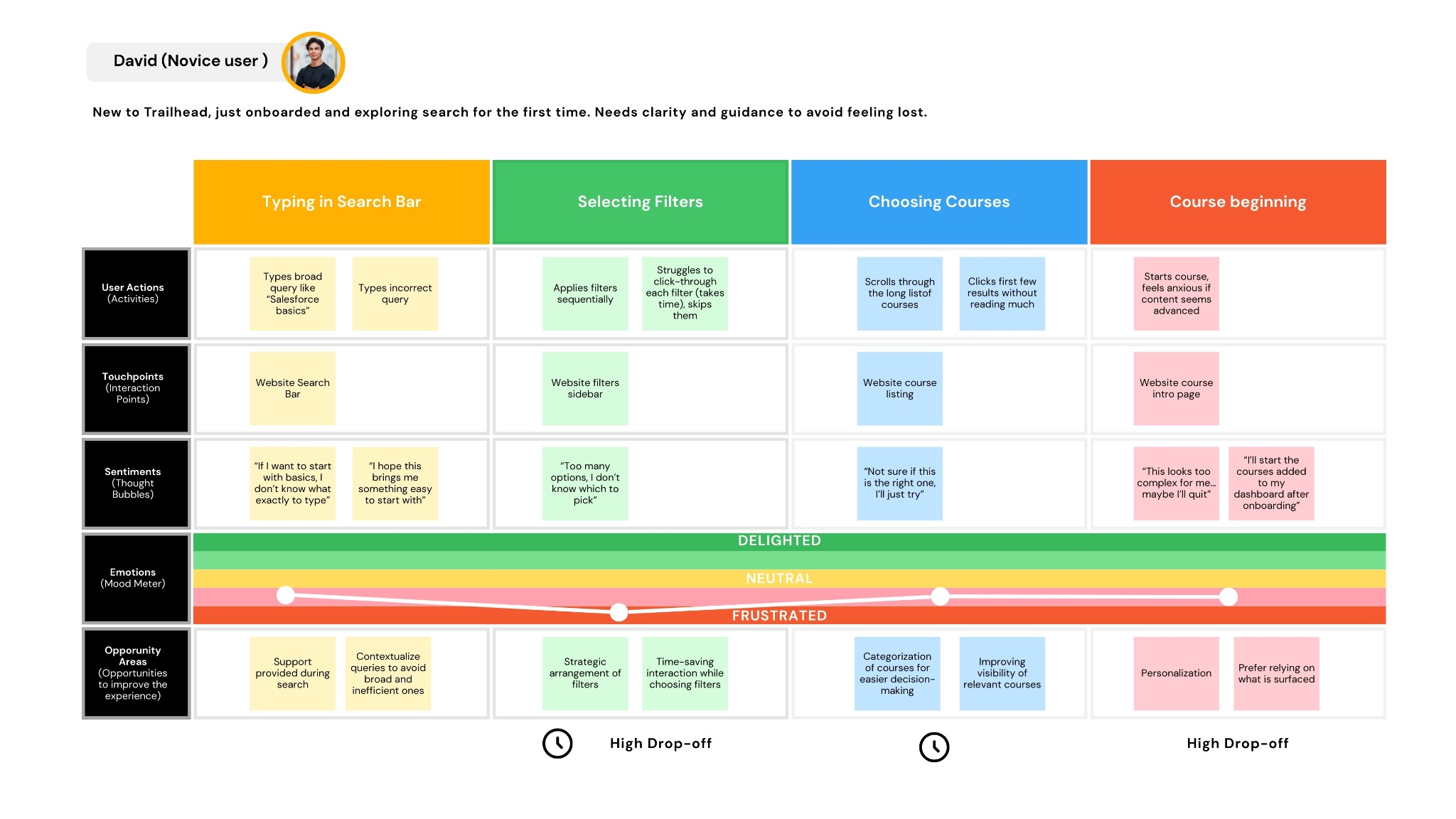
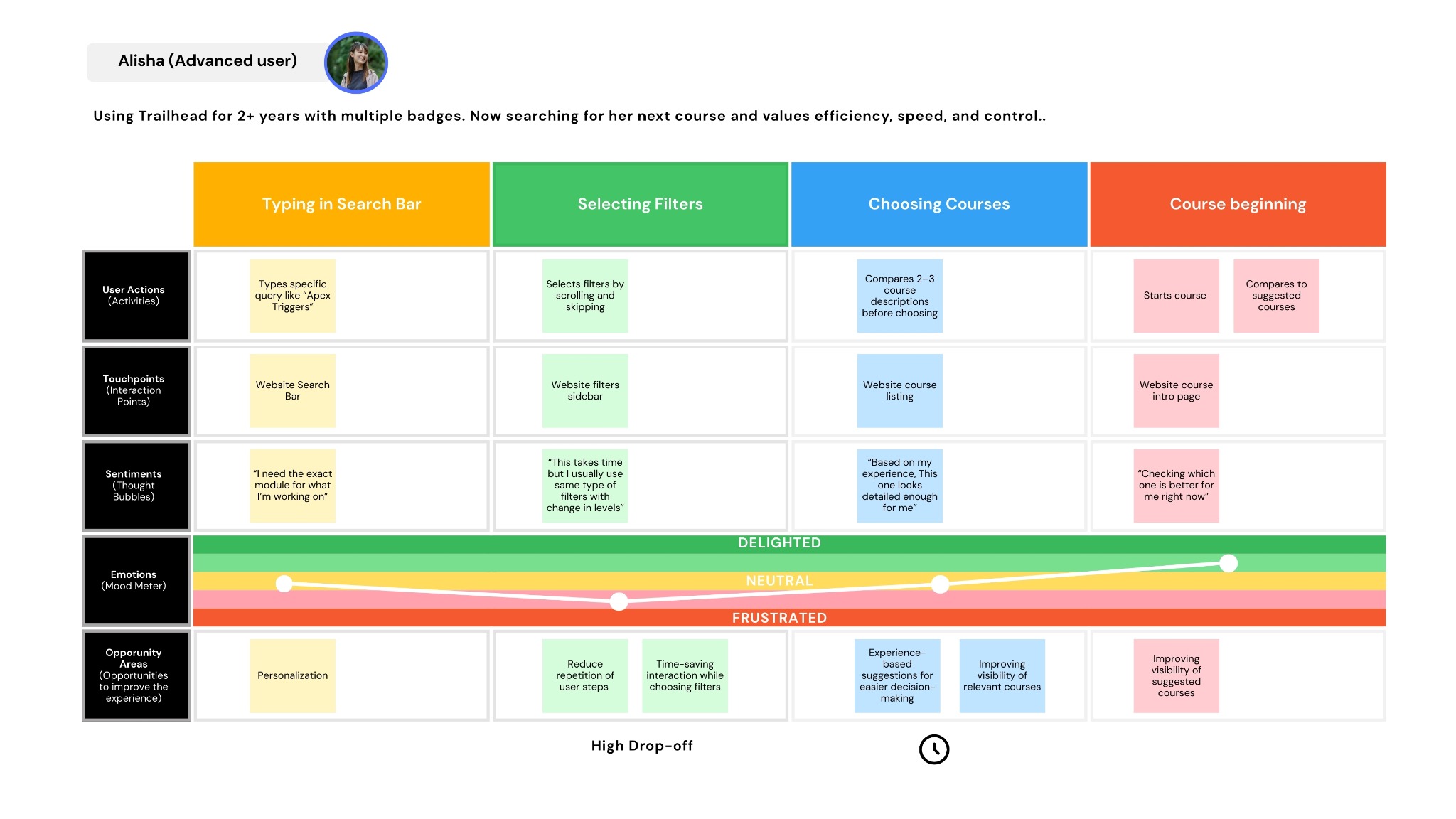
Novice and experienced learners were mapped separately because product familiarity created the clearest differences in search behavior.
Novice pattern
Needs guidance and confidence.
Uncertainty starts before the query and continues through course selection.
Experienced pattern
Needs relevance and speed.
Prior knowledge helps, but repetitive filtering still slows progress.
Novice journey: the strongest opportunities appeared around forming a query, narrowing options, and building confidence before course start.Experienced journey: the strongest opportunities appeared around reducing repeated filtering and surfacing relevant courses sooner.
06 · From opportunities to priorities
I connected each feature idea to a real learner need and a business outcome.
The journey maps showed where the experience could improve. This next step clarified what to build, why it mattered, and which ideas deserved priority.
01
Map the opportunity
Journey mapping located the moments where learners needed guidance, relevance, or less repetition.
→
02
Ideate against needs
Feature ideas were tied to both the observed user need and the business outcome they could support.
→
03
Prioritize with partners
I worked closely with the product manager to balance value, effort, feasibility, and roadmap alignment.
Feature ideation
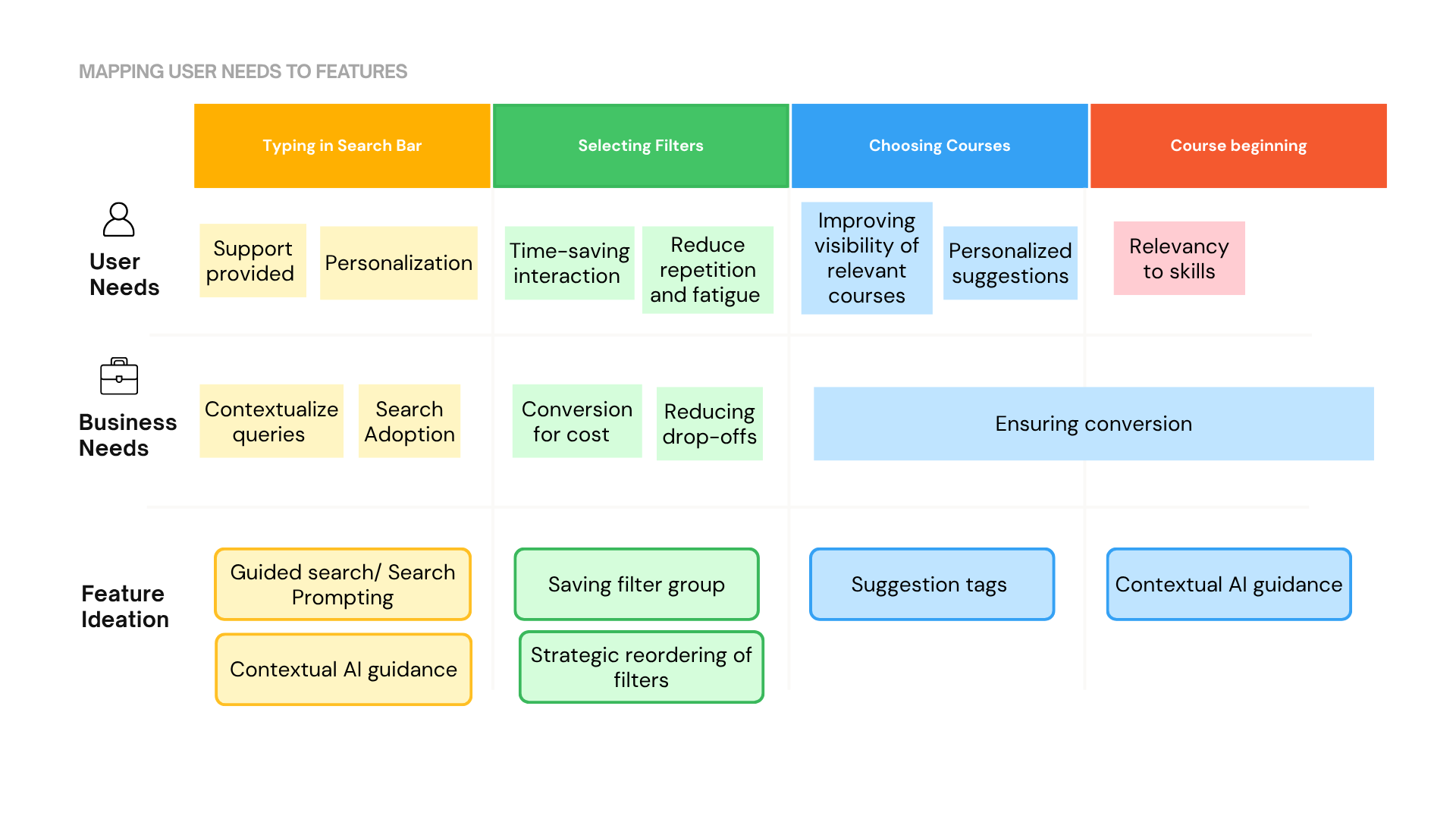
The mapping made the rationale visible.
Every proposed feature could be traced to an existing pain point, a learner need, and a business need. This prevented ideation from becoming a list of disconnected solutions.
Research evidence was translated into feature ideas across each stage of the learner journey.
Prioritization
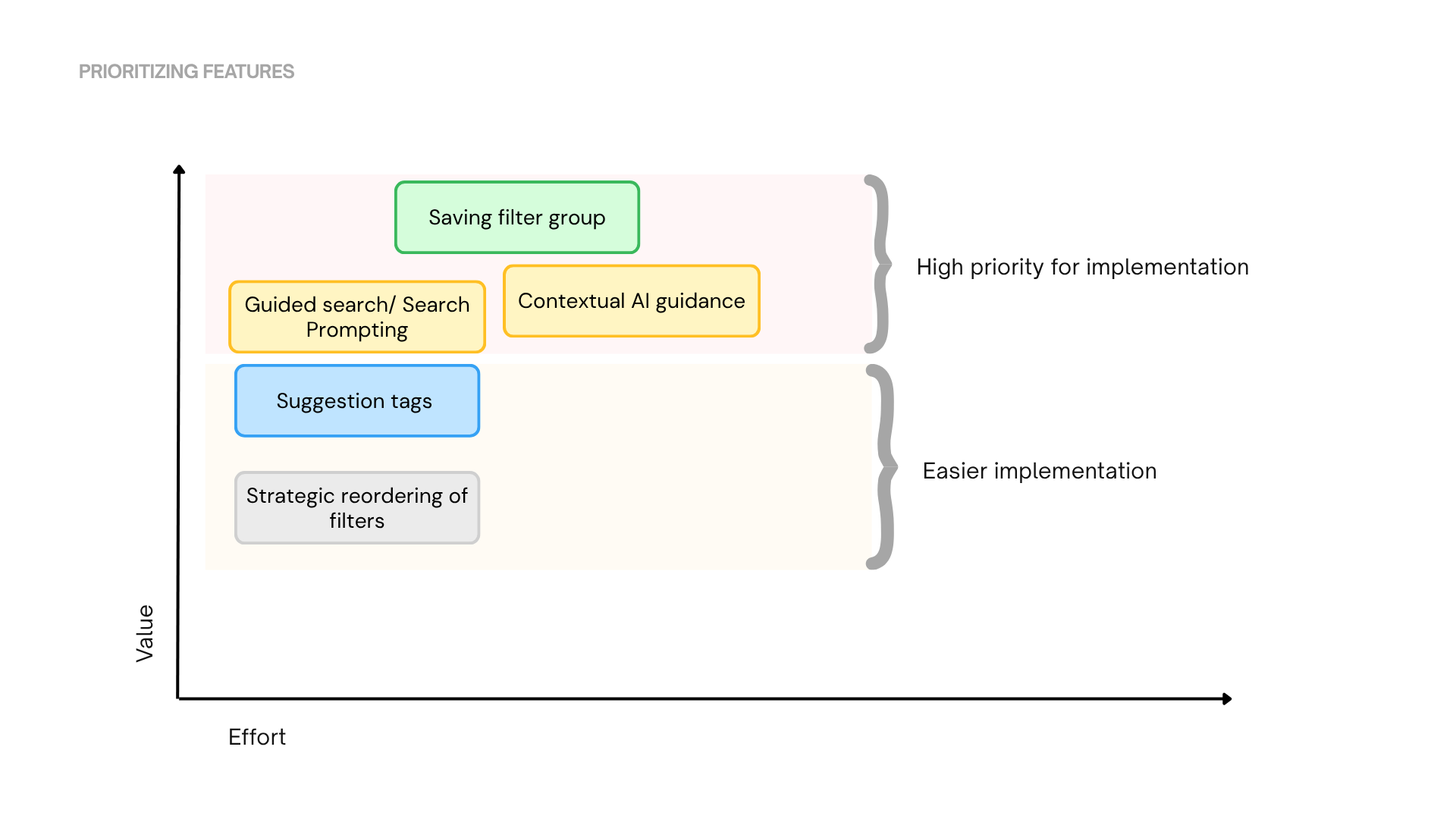
A value–effort matrix converted research opportunities into an implementation sequence.
With the product manager, I evaluated expected learner value against delivery effort, technical feasibility, and roadmap fit. This made tradeoffs explicit and identified saved filter groups, guided search, and contextual AI guidance as the strongest first-phase investments.
The matrix helped separate high-priority opportunities from lower-effort supporting improvements.
07 · Recommendations
Three connected interventions addressed the full decision journey.
The concepts were designed as one system: guide the initial search, provide contextual assistance, and reduce repeated filtering so learners could move from intent to course start with less effort.
01 · Guided discovery
Search prompting gave learners a clearer starting point.
Upfront prompts and suggested pathways helped novice learners translate broad goals into useful searches without requiring Trailhead-specific terminology.
Learners could reuse meaningful combinations instead of rebuilding the same criteria—reducing fatigue, unnecessary refreshes, and time spent before evaluating courses.
I tested whether the recommendations changed the behaviors identified in research.
The second study evaluated the research hypotheses through usability, adoption, and conversion—not visual preference.
Hypothesis 01
Guided search would reduce confusion and increase adoption.
Upfront options were expected to help learners begin without first constructing a precise query.
Hypothesis 02
Reusable filtering would reduce effort, fatigue, and drop-off.
Saved filter groups and a clearer filter order were expected to shorten the path to relevant results.
Study design12
Moderated usability sessions
6 returning experienced learners 6 new student participants
Evaluation framework
Usabilityease, fatigue, timeAdoptionuse of guided searchConversionprogression to course start
What would define success?
Success meant a visible change in learner behavior—not simply positive reactions.
Start with less hesitationLearners use the guided entry point instead of stalling or bypassing search.Reach relevance fasterThey spend less time rebuilding filters and evaluating unsuitable results.Continue to a courseMore learners progress from discovery to a confident course start without dropping out.
09 · Validation impact
Validation showed faster discovery and stronger progression.
Directional prototype evidence showed whether the planned behavioral changes appeared in the study.
Directional+59%
search adoption
Measured−75%
time-on-task
Directional+59%
flow conversion
Observed0
drop-offs
Less effort led to more learners moving forward.
10 · Organizational impact
The research became an enterprise-level investment case.
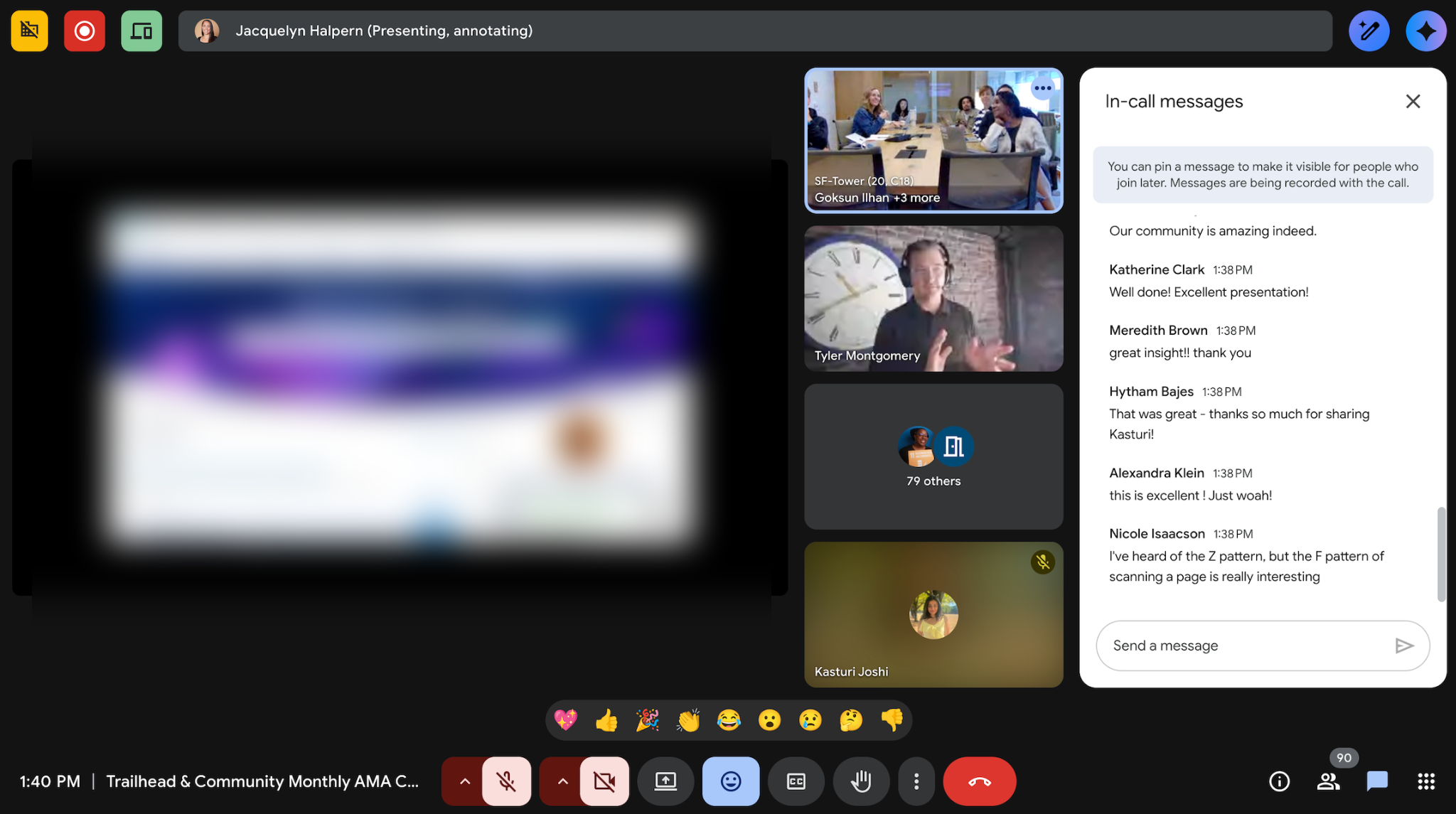
I presented the evidence and validation metrics to the Trailhead VP of Product and Engineering and a broader audience of roughly 100–200 stakeholders.
The final pitch connected learner friction, conversion, user time, search-service cost, and future AI opportunities.
Enterprise influence
I translated research evidence into a decision narrative leadership could act on.
The presentation established a shared rationale for implementation consideration and moved the work beyond a design proposal toward organizational acceptance.
Executive sponsorshipVP-level visibility and implementation supportCross-functional alignmentProduct, UX, engineering, and community shared the rationaleEnterprise scaleA search direction positioned for 3M+ learners
11 · Reflection
In an ideal world, I would have…
With fewer timeline, recruitment, and implementation constraints, I would extend the evidence in three focused ways.
Broadened the sampleInclude more learner backgrounds, accessibility needs, and learning goals.Compared more variantsTest additional discovery and filtering concepts before narrowing the direction.Validated after launchUse production analytics and controlled experiments to confirm impact at scale.