Skeptical Yet Curious About Conversational Assistants
A generative study exploring how conversational assistants might support social engagement for older adults living alone—while preserving trust, privacy, and human agency.
NSF-funded academic research at Indiana University
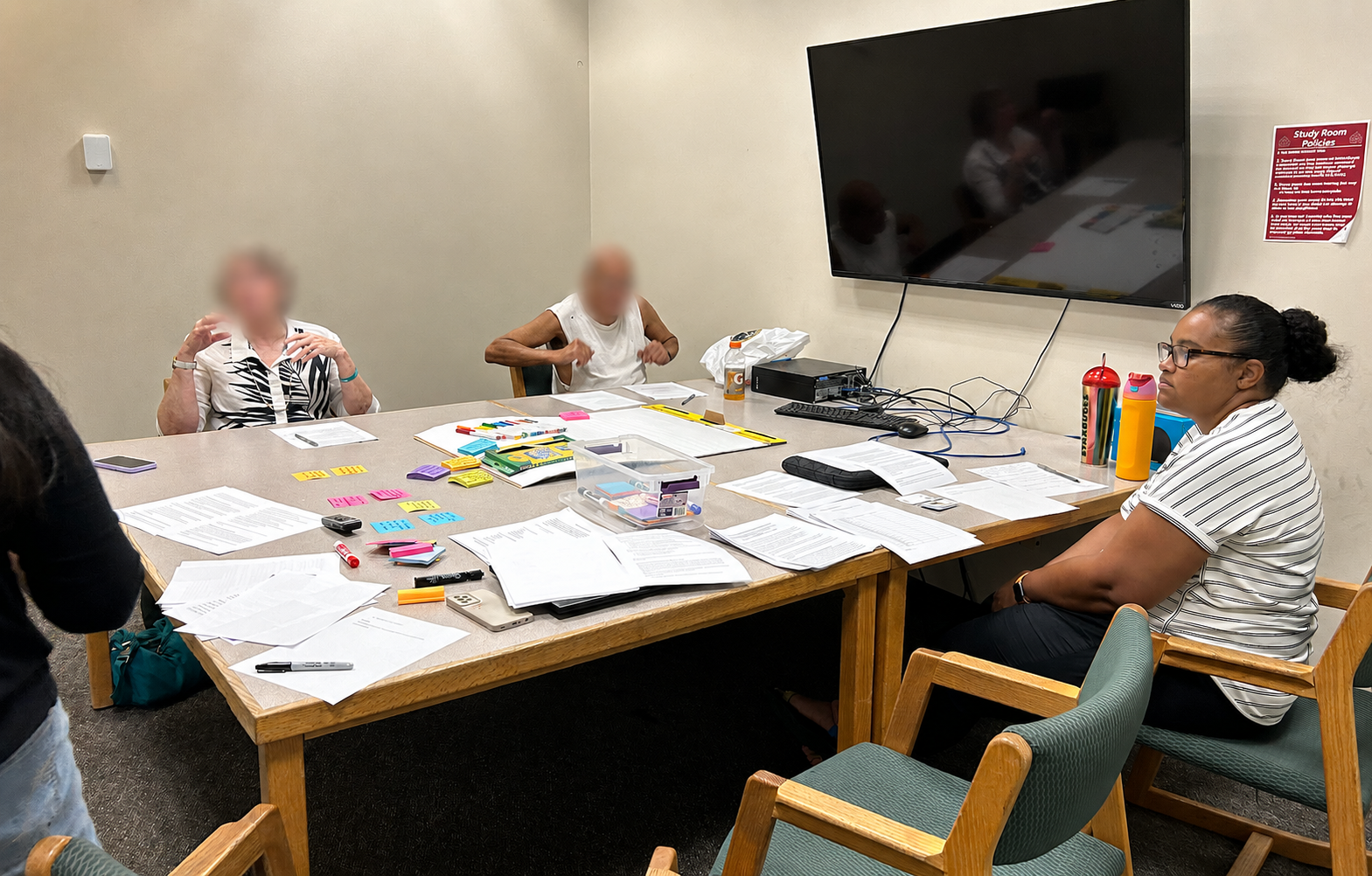
In-person generative research session. Faces are intentionally blurred in this portfolio version to protect participant privacy.
01 · Context
The opportunity was social connection, not artificial companionship.
As people age, forming and maintaining social connections can become more complex—especially for older adults living alone. We wanted to understand whether conversational assistants could help mediate those connections in ways that felt useful and respectful.
Research question
How can conversational assistants mediate interactions and build trust in different social contexts?
The study focused on two use cases: forming new connections for support and maintaining existing relationships through accessible communication.
Why it mattered
This was a high-stakes generative study.
The project was NSF-funded and IRB-governed. That meant the quality of our protocol, screening, moderation, and privacy practices mattered just as much as the insights themselves.
02 · Research approach
We used scenarios to make a future technology concrete enough to discuss.
Because the product idea was still speculative, scenario-based interviews helped participants react to a shared prompt rather than to an abstract question about “AI.” That made the conversations richer and easier to compare across participants.
01
Screen and prepare
We used a short Qualtrics survey to confirm eligibility, gather background information on technology use, and coordinate remote or in-person participation.
02
Introduce the scenarios
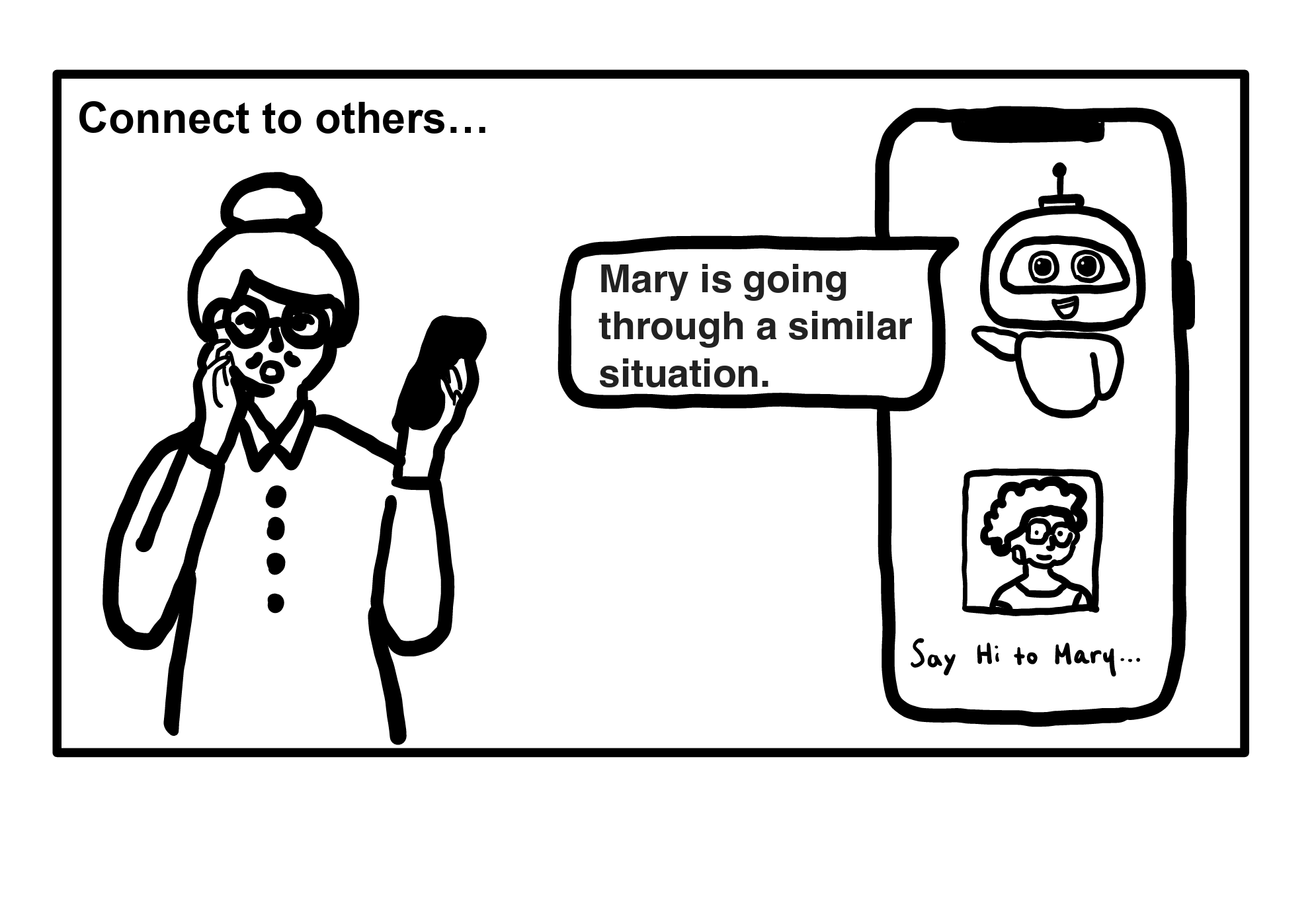
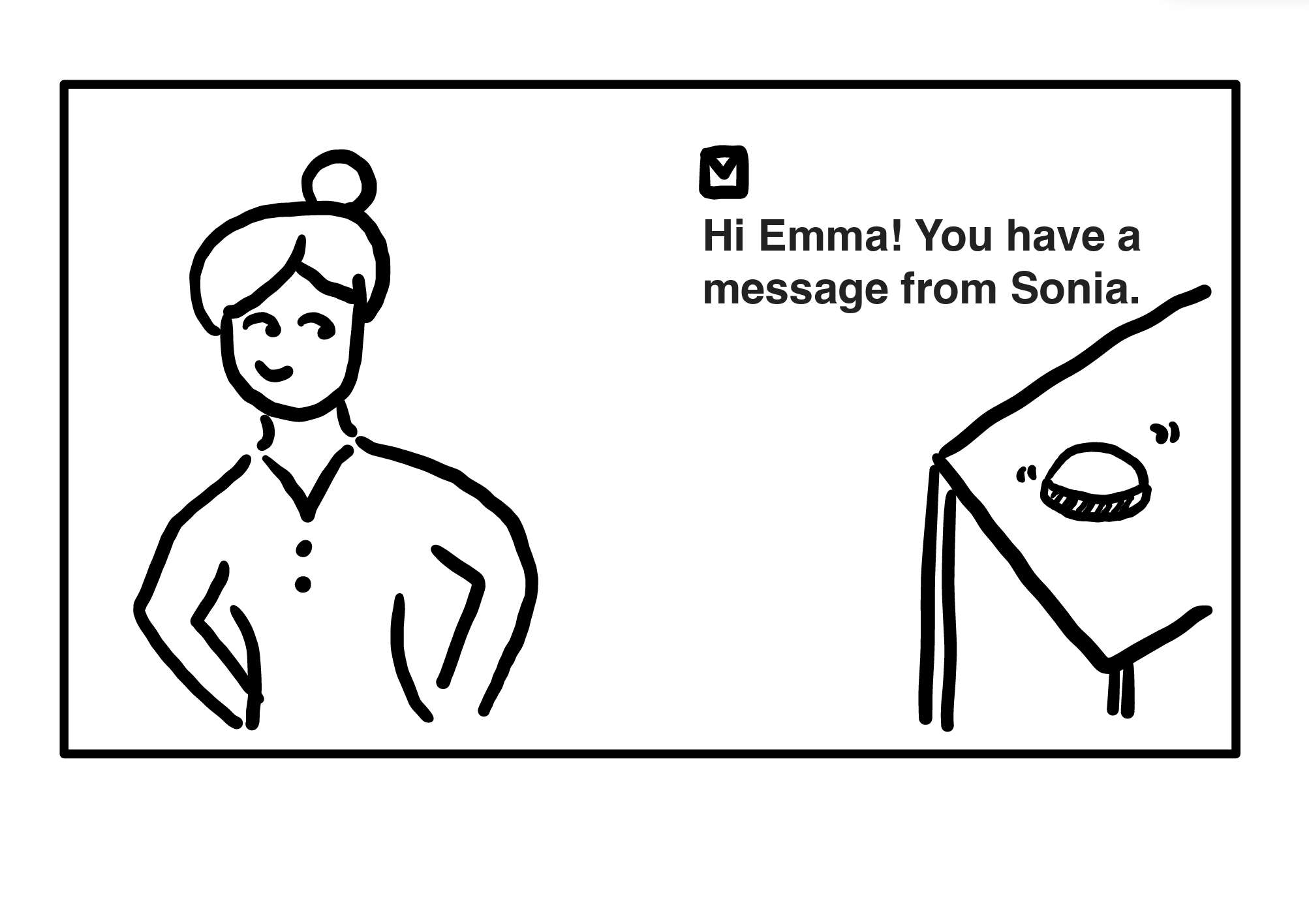
Each participant responded to two visual storyboards that illustrated a possible role for a conversational assistant in social support.
03
Moderate one-on-one sessions
I conducted semi-structured interviews in both remote and in-person formats, asking follow-up questions about usefulness, trust, privacy, and emotional comfort.
04
Synthesize in Miro
We clustered observations and quotes through affinity mapping, compared reactions across the two scenarios, and developed themes grounded in participant evidence.
05
Document and share
Study materials and project files were organized through Microsoft SharePoint, then translated into a poster and paper for ACM CHI 2025.
Qualtricsscreening survey and participant background questionsMiroaffinity mapping and collaborative qualitative synthesisZoomremote one-on-one interviews and scenario discussionMicrosoft SharePointshared research materials, files, and documentation
Ethics & screening
IRB compliance shaped the way the study was run.
Participants were screened to ensure they were 65 or older and living alone.
Qualtrics captured eligibility, basic technology-use background, and participation logistics.
Participants completed consent procedures before any data collection began.
Portfolio visuals use blurring or cropped footage to avoid exposing participant identity.
Research materials, survey exports, and analysis files were handled through approved shared systems.
03 · Scenarios
Two prompts anchored the interviews.
The storyboards helped participants picture what a conversational assistant might actually do. They gave us a consistent way to probe first reactions, practical value, trust, and willingness to engage.
Scenario 1 · Finding new connections with peers who may share similar experiences or support needs.Scenario 2 · Maintaining existing relationships through accessible communication support.
04 · Research in action
Moderation was structured, but the goal was to understand the reasoning behind each reaction.
I use structured, open-ended moderation to understand not only what participants think, but why.
A privacy-safe montage showing moderation posture, scenario framing, and follow-up probing during a remote interview.
05 · Findings
The study ended with a clear tension: participants were skeptical, but they were also curious.
They could imagine value in social-support technology, especially when it reduced coordination effort or made communication easier. But they were cautious about trust, privacy, and assistants stepping too far into deeply human relationships.
The assistant could help people connect. It could not replace the relationship itself.
That distinction shaped the recommendations. Participants were most positive when the assistant acted as a bridge—surfacing opportunities, supporting communication, or making outreach easier—without pretending to know them better than they knew themselves.
“I wouldn’t feel comfortable with it right away… it’s a small matter of trust.”
Participant 6
“I would love to see, like emergency numbers… Being able to say, help, I’ve fallen, and I can’t get up, call 911.”
Participant 1
01
CAs may help with socio-emotional support.
Participants saw more promise in support for making or managing connections than in using the assistant as a substitute companion.
Design implicationDesign for facilitation: help older adults connect with others, not just communicate.
02
Accessible personalized support felt useful.
Participants responded positively when the assistant made communication easier, more tailored, or easier to coordinate around their real needs.
Design implicationPersonalization should be useful and accessible, while staying transparent and controllable.
03
Trust was the biggest boundary.
Participants were skeptical about matchmaking, emotional assumptions, and systems that seemed to infer too much or move too fast.
Design implicationSupport gradual, user-paced relationship building and give people control over how the assistant works.
Synthesis
From raw notes to design implications.
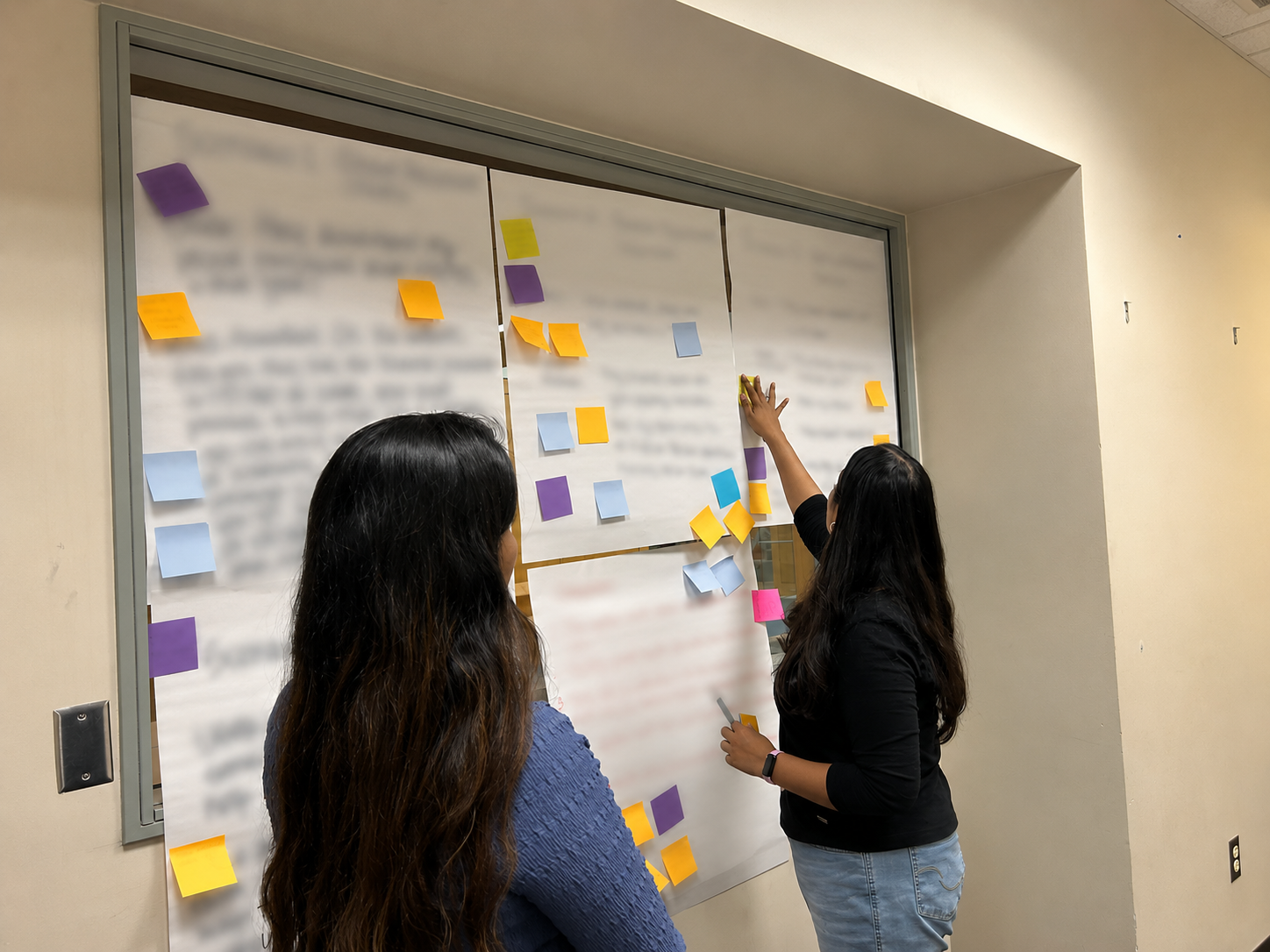
We began organizing evidence during the sessions, then completed the cross-participant synthesis afterward. The physical wall helped us preserve each scenario’s context before moving the full dataset into Miro.
During and immediately after sessions, we placed concise observations beneath the relevant scenario prompt. This preserved which reactions belonged to finding new connections versus maintaining existing ones before digital synthesis.Two-stage synthesis
The physical wall set the ground; Miro supported the full analysis.
For each scenario, we captured short observations about participants’ immediate reactions, questions, concerns, and moments of interest. Keeping these notes beside the scenario made the context visible while sessions were still fresh. After data collection, we transferred and expanded that evidence in Miro for cross-participant affinity mapping.
Separated observations by Scenario 1 and Scenario 2
Captured repeated reactions around usefulness, trust, privacy, and control
Used Miro to compare participants, cluster evidence, and define the final themes
06 · Impact
The work moved from field notes to the global HCI community.
This was a generative study, so the outcome was not a product metric. The impact was that the work became a published contribution, a public conversation at CHI, and a strong example of end-to-end UX research rigor.
Peer-reviewed publicationThe study was published in the CHI 2025 Extended Abstracts.Conference presentationI presented the work in Yokohama, sharing the research with the international HCI community.Research craft on displayThe project shows my ability to handle recruitment, compliance, one-on-one qualitative moderation, synthesis, and dissemination.
Presenting the published research at CHI 2025 in Yokohama. The clip autoplays silently when it enters view.
07 · Reflection
In an ideal world, I would have taken the study one step further.
The project answered an important generative question, but it also opened up clear opportunities for future work.
Next step
Test a real prototype.
Scenario-based interviews helped us understand attitudes. The next step would be testing a real prototype to see how trust changes in use, not just in discussion.
Next step
Study longer-term adoption.
I would want to follow participants over time to understand whether skepticism softens, grows, or shifts with repeated use and real relationship outcomes.
What I learned
Generative research can still be rigorous.
Even when the goal is exploratory, careful screening, thoughtful moderation, and disciplined synthesis are what make the findings credible enough to publish.